Hand-building guide
How to calculate clay shrinkage for pottery templates
By Slab Marks · Updated October 2026
The short answer: divide the finished size you want by (1 − shrinkage). For a clay that shrinks 12%, divide by 0.88, so a mug that should be 4 in tall after firing needs a 4.55 in tall slab. Don't multiply by 1.12: that leaves the piece slightly too small.
Rather skip the math? The free Slab Marks template maker applies shrinkage for you and prints a to-scale template. See how it works ↓
Make my template, freeWhy clay shrinks
Wet clay is full of water. As a piece dries, the water leaves and the clay particles pack closer together, so it shrinks. Firing shrinks it again as the clay tightens and partly melts. Clay makers usually quote total shrinkage, from wet to fired, as a percentage of the wet size.
Shrinkage happens in every direction, so it affects everything you cut: the height, the width of the wrap, the base disc, handles and lids.
The formula
Cut size = finished size ÷ (1 − shrinkage)- Turn the percentage into a decimal: 12% becomes 0.12.
- Subtract it from 1: 1 − 0.12 = 0.88.
- Divide each finished measurement by that number: 4 in ÷ 0.88 = 4.55 in.
Working from the slab the other way, the fired size is the cut size × (1 − shrinkage): 4.55 in × 0.88 = 4.00 in.
Why multiplying by 1.12 is wrong
Because shrinkage is a percentage of the wet size, adding 12% to the fired size doesn't put it back. For a 5 in target, 5 × 1.12 = 5.60 in, but the right answer is 5 ÷ 0.88 = 5.68 in. A 5.60 in slab fires to 4.93 in. The gap is small on one measurement, but it shows up when a lid doesn't fit or a set of mugs comes out a size smaller than planned, and it grows with higher shrinkage.
Shrinkage tables: what size to cut
Find the finished size you want, then read across to your clay's shrinkage rate. Typical rates: low-fire earthenware ~7%, mid-fire stoneware ~12%, high-fire stoneware ~13%, porcelain ~15%.
| Finished size | 7% | 12% | 13% | 15% |
|---|---|---|---|---|
| 3 in | 3.23 | 3.41 | 3.45 | 3.53 |
| 3.5 in | 3.76 | 3.98 | 4.02 | 4.12 |
| 4 in | 4.30 | 4.55 | 4.60 | 4.71 |
| 4.5 in | 4.84 | 5.11 | 5.17 | 5.29 |
| 5 in | 5.38 | 5.68 | 5.75 | 5.88 |
| 6 in | 6.45 | 6.82 | 6.90 | 7.06 |
Cut size in inches, rounded to 0.01 in.
| Finished size | 7% | 12% | 13% | 15% |
|---|---|---|---|---|
| 8 cm | 8.6 | 9.1 | 9.2 | 9.4 |
| 9 cm | 9.7 | 10.2 | 10.3 | 10.6 |
| 10 cm | 10.8 | 11.4 | 11.5 | 11.8 |
| 12 cm | 12.9 | 13.6 | 13.8 | 14.1 |
| 15 cm | 16.1 | 17.0 | 17.2 | 17.6 |
Cut size in centimetres, rounded to 0.1 cm.
Shrinkage and mug capacity
A mug loses far more volume than height, because it shrinks in all three directions at once. Volume shrinks by (1 − shrinkage)³, so 12% shrinkage takes away about 32% of the volume. That's why a mug that looks generous when it's wet can come out of the kiln holding much less.
| Shrinkage | Volume lost | Wet capacity for a 12 oz mug |
|---|---|---|
| ~7% | 20% | 14.9 oz |
| ~12% | 32% | 17.6 oz |
| ~13% | 34% | 18.2 oz |
| ~15% | 39% | 19.5 oz |
Capacity of the inside space, before glaze. Glaze and a thick base take up a little more room.
Ready-made sizes: how big to cut a slab for a 12 oz mug.
How to measure your own clay's shrinkage
Published rates are averages. Your clay, your kiln and how hot you fire all change the number, so a quick test tile is worth it before a big batch.
- Roll a slab of the clay you'll use, the same thickness as your project.
- Draw a line exactly 10 cm long on the wet slab with a ruler and a needle tool. A longer line, like 20 cm, gives a more precise result.
- Dry it slowly, then fire it the same way as your finished work: bisque, then glaze firing at your usual temperature.
- Measure the line again and work out: shrinkage % = (10 − fired length) ÷ 10 × 100. A line that measures 8.8 cm means 12%.
- Write it on the tile with the clay name and the firing temperature, and keep it.
How to do it in Slab Marks
The free template maker does every calculation on this page for you. You only ever type the finished size you want.
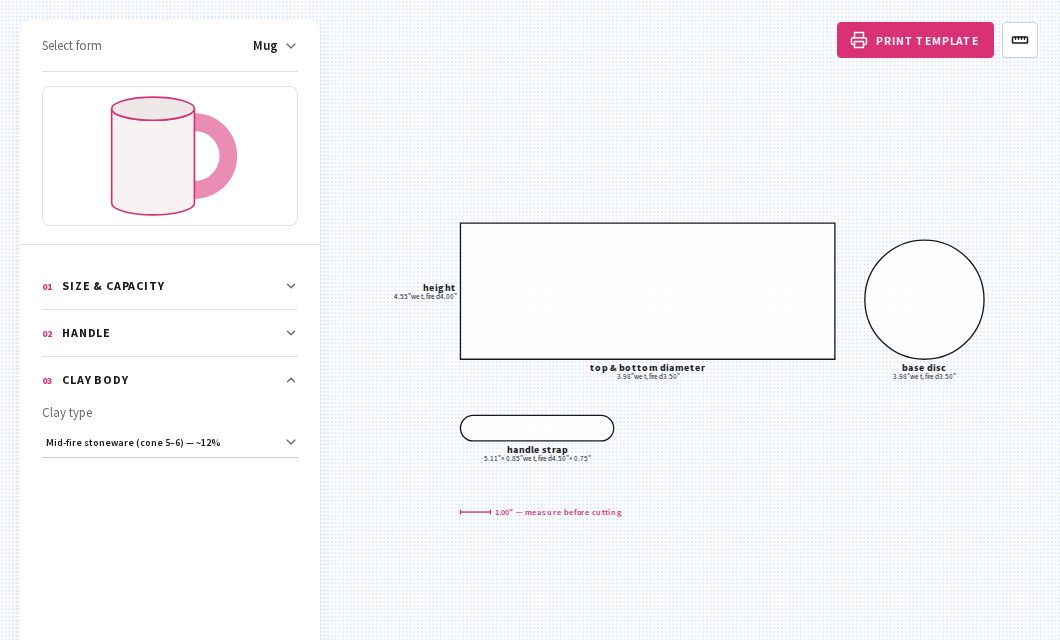
- On the homepage, pick your form, for example Mug.
- Enter the finished size you want, like a 3.5 in wide, 4 in tall mug.
- Open Clay body and pick earthenware, mid-fire or high-fire stoneware, or porcelain. If you've tested your clay, choose Custom and type your own percentage.
- Every label on the template shows both sizes: wet, what you cut, and fired, what you'll get. For the mug above that's 4.55 in wet for 4.00 in fired, the same as the table.
- Click Print template, then Print directly, at 100% scale.
Common questions
Do I apply shrinkage to the wall thickness too?
The walls shrink too, but you choose the slab thickness for strength and handling, so most hand-builders don't scale it. What matters for a template is the outline: height, width and the base.
Why not just add the shrinkage percentage?
Shrinkage is measured as a percentage of the wet size, not the fired size. Adding 12% (multiplying by 1.12) undersizes the piece: for a 5 inch target it gives 5.60 inches instead of the correct 5.68 inches, and the error grows with higher shrinkage.
Is drying shrinkage different from firing shrinkage?
Yes. Some clay data sheets list them separately. For templates, use the total figure, from wet to fully fired, because that's the difference between the slab you cut and the piece you keep.
Does underfiring change shrinkage?
Yes. A clay fired cooler than its intended temperature shrinks less, and one fired hotter shrinks more. Test at the temperature you actually use.
Next: put the numbers to work in how to make your own pottery templates.
Be first to know
Join the list for new template forms and easy hand-building project ideas for those "okay… now what?" moments.
No spam, unsubscribe anytime. How I handle your email