Hand-building guide
How thick should my slabs be?
By Slab Marks · Updated October 2026
The short answer: for most hand-built mugs, cups and tumblers, roll slabs 1/4 in (about 6 mm) thick. Go thinner, 1/8 to 3/16 in (3 to 5 mm), for small, light pieces, and thicker, up to 3/8 in (about 10 mm), for big plates, platters and tall pieces. Whatever you pick, keep every piece of one project the same thickness so it dries and shrinks evenly.
Want to see how much a thicker wall takes out of your cup? The free Slab Marks template maker shows it as you type. See how it works ↓
Make my template, freeSlab thickness chart
These are starting points. Smaller pieces can go thinner, bigger ones thicker.
| What you're making | Inches | mm |
|---|---|---|
| Ornaments, pendants, small trinket dishes | 1/8–3/16 | 3–5 |
| Mugs, cups and tumblers | 3/16–1/4 | 5–6 |
| Mug handles cut from a slab | 1/4 | 6 |
| Lids and small boxes | 3/16–1/4 | 5–6 |
| Plates, trays and spoon rests | 1/4 | 6 |
| Large platters, planters and tall vases | 1/4–3/8 | 6–10 |
| Tiles and coasters | 1/4–3/8 | 6–10 |
1/4 in is 6.35 mm, so 6 mm and 1/4 in are close enough to swap.
What changes when you go thinner or thicker?
Thinner slabs
- Lighter, finer pieces that feel nice in the hand.
- Use less clay.
- But they slump when you build tall, warp more easily, and their edges dry and crack faster. Joins are harder because there's less clay to score.
Thicker slabs
- Sturdier, easier to handle, and seams have more clay to grip.
- Good for big flat pieces that would otherwise warp.
- But they're heavy, take longer to dry, and are more likely to crack if the inside stays wet while the outside dries. Let thick pieces dry slowly and completely before they go in the kiln.
How thickness changes what a cup holds
The outside of a cup stays the same size whatever the thickness, so a thicker wall eats into the space inside. Here's a straight tumbler 3.5 in wide and 4.5 in tall, filled to the brim:
| Wall and base | Holds |
|---|---|
| 1/8 in (3 mm) | 20.1 oz |
| 3/16 in (5 mm) | 18.3 oz |
| 1/4 in (6 mm) | 16.6 oz |
| 3/8 in (10 mm) | 13.6 oz |
Going from 1/8 in to 3/8 in walls costs about 6.5 oz, nearly a third of the cup. If you're aiming for a set capacity, decide the thickness first. More on sizing in how big to cut a slab for a 12 oz mug.
Keep every piece the same thickness
Thin and thick parts dry and shrink at different speeds. Where they meet, at a seam or where the wall sits on the base, the difference pulls the join apart and cracks it. So roll the wall, the base and any lid from the same slab, or at the same setting. For very large platters, a base a little thicker than the walls is fine.
How to get an even thickness
- Roll between guide sticks. Two strips of wood the thickness you want, one each side of the clay. When the rolling pin rides on both sticks, the slab is done. Full steps in how to roll a clay slab.
- On a slab roller, set the gap to your thickness and remember the canvas adds a little. Measure a test slab.
- To check a slab, push a needle tool straight in until it touches the table, pinch it at the clay's surface, pull it out and measure.
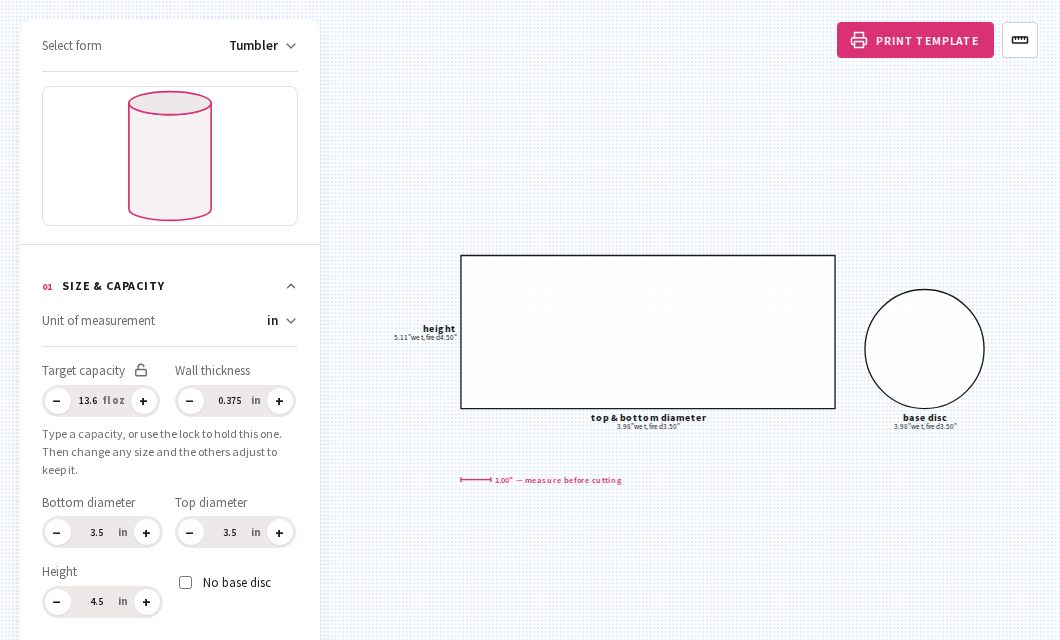
How to do it in Slab Marks
- On the homepage, pick your form, for example Tumbler.
- Enter your sizes, then type your slab thickness in Wall thickness, in inches or millimetres.
- The Target capacity updates straight away, so you can see how much the cup will hold at that thickness. The template itself stays the same, because the sizes you enter are outside sizes.
- Aiming for a set capacity? Click the lock next to it first. Then changing the thickness adjusts the sizes instead, so the cup still holds what you asked for.
Common questions
Is 1/4 inch too thick for a mug?
No. 1/4 in (about 6 mm) is the most common thickness for slab mugs: sturdy enough to build with and not too heavy. Go down to 3/16 in once you're comfortable for a lighter mug.
How thin can I roll a slab?
About 1/8 in (3 mm) for small, flat pieces like ornaments. Thinner than that gets fragile and warps easily.
Should the base be thicker than the walls?
For mugs and cups, keep it the same. For large platters, a slightly thicker base helps them stay flat.
How thick is a slab in millimetres?
1/8 in is about 3 mm, 3/16 in about 5 mm, 1/4 in about 6 mm and 3/8 in about 10 mm.
Be first to know
Join the list for new template forms and easy hand-building project ideas for those "okay… now what?" moments.
No spam, unsubscribe anytime. How I handle your email